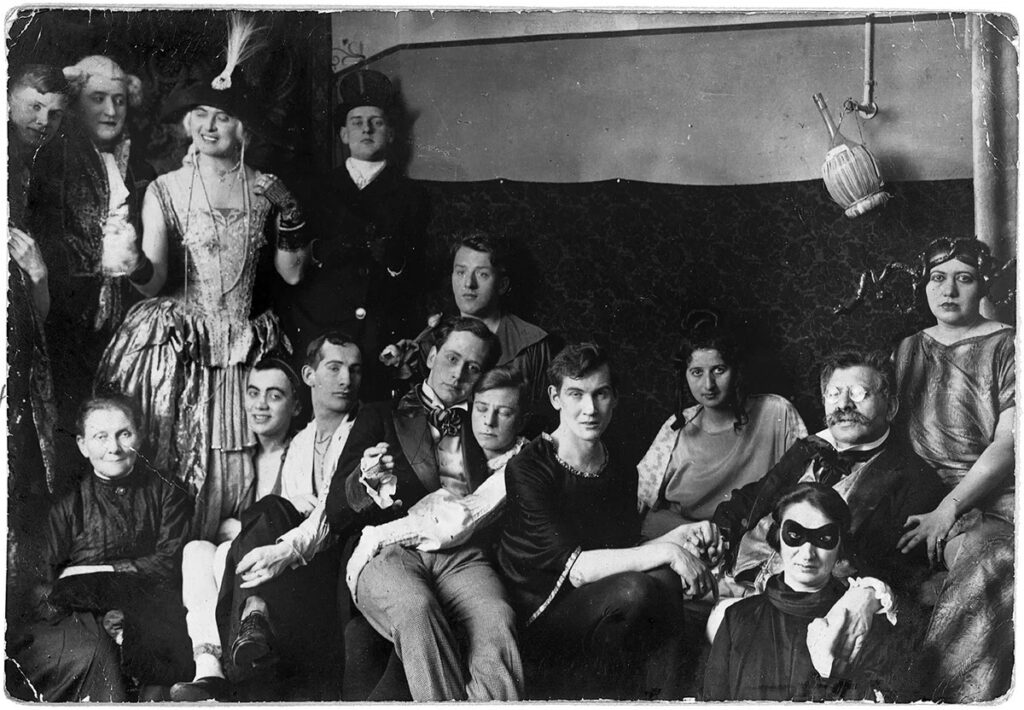
Afbeelding: The Institute of Sexual Science as refuge ca. 1919. Photographer unknown. Copyright: Magnus-Hirschfeld-Gesellschaft
One hundred years ago, a peculiar institute opened its doors in Berlin; the “Institut für Sexualwissenschaft” (Institute for Sexual Science). First of its kind, this place sought to research and help a range of people who could be characterized as “gender outlaws”. These people, who using the language of today we would call gay, queer, intersex, or trans, found refuge, community, and access to healthcare. Hormonal and surgical services were, for the first time, offered to people to affirm their gender identity.
The history behind the emergence of this “gender-affirming medicine” and the politics that formed its development is rich and complex. Sadly, as is often the case with queer histories, this intriguing past remains hidden and even invisibilized. Historian Alex Bakker has taken on the important task of unveiling this history and presenting it to the public.
During this programme Bakker will offer a lecture on an important moment in queer history and open a conversation on the historical forms of gender-affirming medicine, providing a platform for us to reflect on the current state of affairs.
Sprekers
Alex Bakker is a historian and writer who also works as a researcher for television drama, documentaries and exhibitions. Bakker specializes in (Dutch) transgender history and has published the groundbreaking Transgender in Nederland. Een buitengewone geschiedenis (Boom Uitgevers, 2018), followed by The Dutch Approach. Fifty years of transgender health care at the VU Amsterdam gender clinic (Boom Uitgevers, 2021). He is co-author of Others of My Kind: Transatlantic Transgender Histories (University of Calgary Press, 2020) that was awarded 2021 Choice Outstanding Academic Title. At the moment he is working on a book about the first steps in transgender health care and community building that took place in Berlin in the 1920s.
Leo Ranieri (moderator) has a multidisciplinary background spanning the biomedical sciences, medical anthropology, politics, and philosophy. His interest lays at the nexus of these disciplines, particularly around the notion of “the human” and who gets to be considered as such. He mobilises a philosophical repertoire inspired by the biomedical sciences to speculate towards a novel conceptual vocabulary geared at contemporary political problems, notably questions of borders, gender, and identity.
